Ismael's killing of David
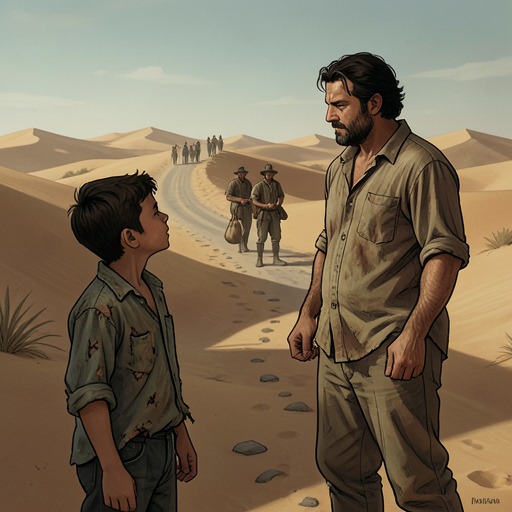
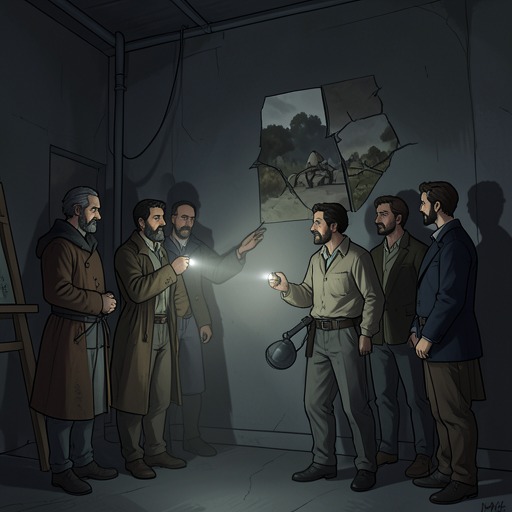
The ForgivenIsmael’s killing of David turns a roadside stop into the final collision between a concealed act of responsibility and a delayed act of violence. As David and Jo slow near the place where the police ribbon still marks the road, Ismael steps out to intercept them with a fossil in one hand and a revolver in the other. The attack is not an arbitrary encounter: Ismael has been waiting for a car, and he recognizes in David the man who buried Driss’s identification after the fatal collision. David, in turn, understands what Ismael’s presence means only when the attack is already underway.
Background and the plan with Driss
Ismael’s ambush grows out of a plan he had made with Driss on an earlier Friday night. The two had travelled from Erfoud with the Elvis fossil and other specimens, hitching a lift and getting off where a cement truck left them. They were waiting on a stony hill, watching for passing cars. Driss, in a dark mood after quarrelling with his father, proposed stopping the first car they saw. He expected its occupants to carry cash and to be easy to overpower. His plan made a passing vehicle into an opportunity for robbery; Ismael’s later vigil continues that expectation, but turns it toward the Hennigers.
Driss assigned Ismael the act of shooting, calling it his initiation. That expectation gives the planned robbery a particular weight: Ismael was not merely to accompany Driss or help take money, but to cross a threshold into violence. The later attack echoes the scheme while changing its immediate context. Driss is dead, and Ismael is alone on the hill, holding the weapon and waiting for the people he seeks.
Ismael’s vigil and the roadside encounter
Ismael spends much of the day watching the road from a makeshift shelter of a coat supported by three sticks. When vehicles associated with the guests from Azna pass, he repeatedly goes down the hillside to check whether they are the two people he is looking for. The search is tiring and repetitive. After night falls and traffic thins, he shivers beneath the coat and prepares the heavy pistol Abdellah had given him. He keeps the events of Friday night to himself, so the narration reveals the robbery plan through his recollection rather than through any confession to the people he is about to stop.
The Hennigers approach near the police ribbon, with a stony hill rising beside the road. Ismael runs down from it and steps into their path, raising a palm-sized Psychopyge fossil and shouting for them to stop. David brakes. The fossil is part of Ismael’s approach, as if he were simply another person offering a specimen by the roadside; the revolver he carries makes that ordinary-looking encounter a trap. He advances confidently, holding the fossil in his left hand and the loaded revolver in his right.
Jo lowers her window with a searching, sympathetic expression, while David relaxes his hands on the wheel and turns off the engine. Ismael reads their trust as a failure to recognize danger. He greets them, and their astonishment suggests that they recognize him, but he does not regard forgiveness as his to give. When Jo leans toward the window to see him more clearly, Ismael drops the fossil and raises the revolver. He moves around the rear of the car as David opens the door.
Recognition, responsibility, and death
David’s response is not described as panic. His eyes show curiosity and wonder, and Ismael’s memory supplies the reason the encounter has become personal: he remembers David digging a small hole to bury Driss’s identification. Ismael interprets that concealment as characteristic of an outsider. David, for his part, suddenly understands the connection. The scene brings his hidden conduct back into view at the moment he can no longer undo it.
The narration follows David’s perception as he concludes that he could not have changed what was happening and finds the idea of free choice absurd. At the same time, he has already forgiven himself; the thought that he has not been forgiven does not lead him to recognize why. The attack therefore confronts two different understandings of responsibility: Ismael holds onto the evidence of David’s concealment, while David has treated self-forgiveness as if it had settled the matter. The encounter ends with Ismael killing him before he can speak.
David tries to form a word, but cannot say it. His final recognition is an apology directed toward Ismael, conveyed only in his eyes and too late to become an audible appeal. The turbine nightmare from earlier in the day returns in the narration as the image through which David’s death is rendered; he closes his eyes as the scene ends. The attempted apology does not reverse the violence or secure forgiveness. Instead, the final moment leaves David’s remorse beside the irreversible consequence of his earlier concealment, while Ismael’s attack completes the violent turn begun in the abandoned roadside robbery plan.